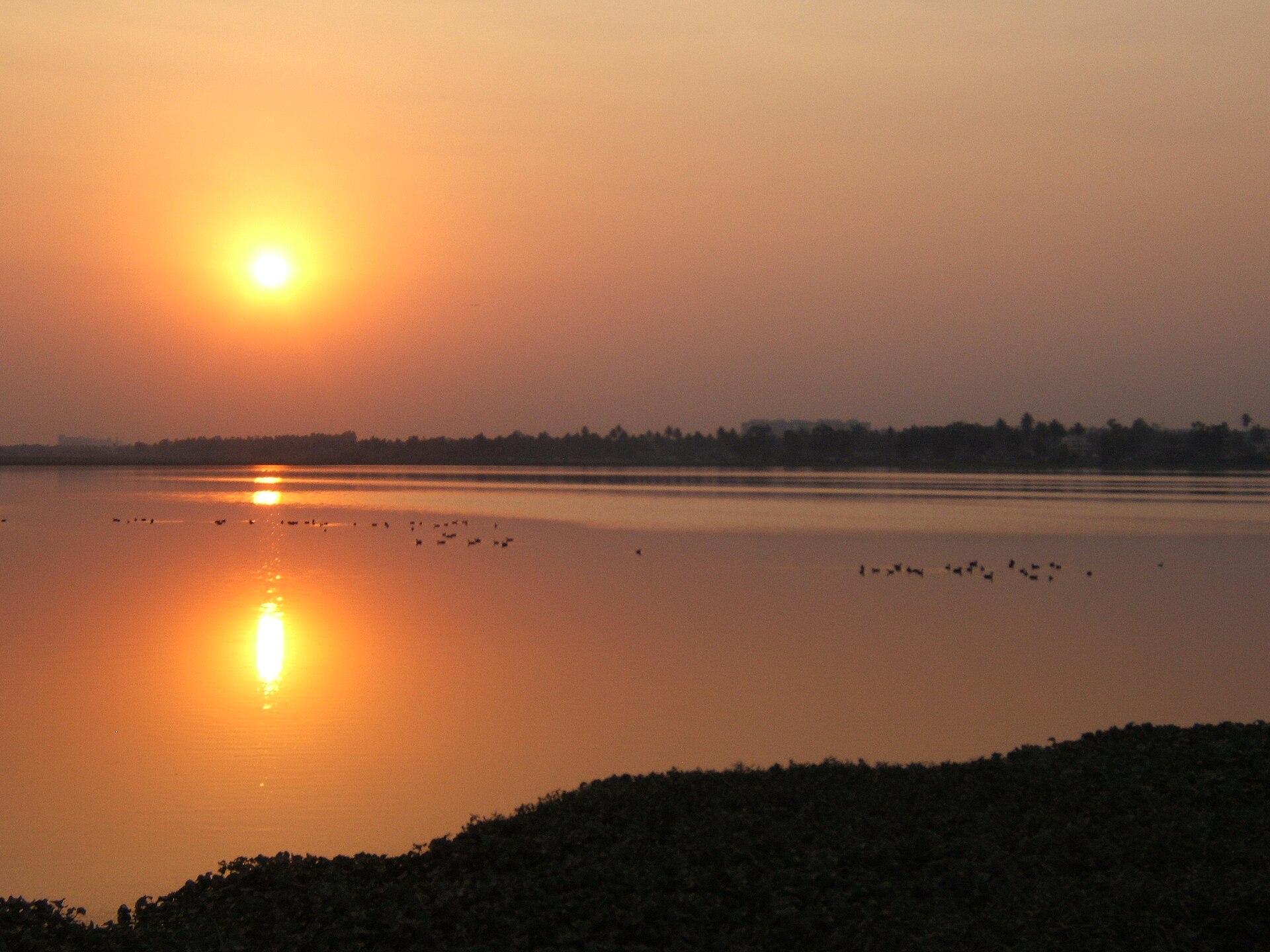
A lakefront home in East Bangalore can be the best address in the city or a costly mistake, and the difference comes down to three checks: how far the building sits from the lake’s full tank line, whether it is near an encroached storm-water drain, and how it fared in the September 2022 floods. Karnataka’s 2025 amendment to the lake protection law cut buffer zones for small lakes to as little as 3 to 12 metres, but lakes larger than 100 acres, including Varthur (445 acres) and Bellandur, keep the 30-metre buffer. Size of lake, distance and drainage matter far more than the view.
This guide explains the buffer rules as they stand in 2026, what the 2022 floods revealed about the Bellandur–Varthur valley, where lake restoration has reached, and a step-by-step check you can run on any lakefront home.
Why lakes in East Bangalore behave differently
Bengaluru’s lakes were built as a connected chain of tanks, each overflowing into the next through channels called rajakaluves. In the east, water flows from the city centre through Bellandur Lake, about 890 acres, into Varthur Lake, about 445 acres, and on out of the city. A home beside one of these lakes is not just beside a body of water; it sits in a drainage valley that carries much of the city’s runoff in a heavy storm.
That has two consequences. A restored lake brings open views, cooler air and a lasting price premium. But when channels upstream are encroached or narrowed, rain has nowhere to go, and low-lying land near the valley floods. Both the upside and the risk are real, and both are measurable.
Buffer zone rules in 2026: what changed
A buffer zone is the no-build strip measured from a lake’s full tank line, the edge of the water when the lake is full. The rules have changed several times, as Citizen Matters has traced:
| Year | Rule |
|---|---|
| 2012 | Karnataka High Court directs a 30 m buffer for lakes and 50 m for primary drains |
| 2015 | Revised Master Plan: 30 m for lakes; 50 m, 25 m and 15 m for primary, secondary and tertiary drains |
| 2016 | National Green Tribunal widens lake buffers to up to 75 m |
| 2019 | Supreme Court sets aside the 75 m order and restores the 2015 norms |
| 2025 | KTCDA (Amendment) Act scales the lake buffer to lake size |
The 2025 amendment was passed by the legislature in August 2025, returned by the Governor for clarification, and later notified, Deccan Herald reported. It replaces the uniform 30 m buffer with a sliding scale:
| Lake area | Buffer from full tank line |
|---|---|
| Up to 0.05 acre | None |
| 0.05 to 0.1 acre | 1 m |
| 0.1 to 1 acre | 3 m |
| 1 to 10 acres | 6 m |
| 10 to 25 acres | 12 m |
| 25 to 100 acres | 24 m |
| Over 100 acres | 30 m (unchanged) |
The amendment is also expected to allow roads, bridges, water lines and sewage treatment plants inside buffers, provided the lake’s capacity and natural inflow and outflow are not reduced. The Federation of Bengaluru Lakes, representing 47 citizen groups, opposed the change and said it would challenge it, noting a pending suo motu case before the National Green Tribunal. Treat the rules as settled law today but not beyond legal challenge.
What it means for Varthur and Bellandur
Both lakes are well above 100 acres, so their buffer stays at 30 metres. Minor Irrigation Minister N S Boseraju said in October 2025 that most of Bengaluru’s 187 lakes are larger than 100 acres and would be unaffected, SANDRP reported. The change bites hardest around small neighbourhood lakes, where a project could now legally sit a few metres from the water. If you are buying near a small lake, the margin for error is much thinner than it was.
Storm-water drain buffers are a separate rule. After the lake amendment, the Urban Development Department issued a draft notification to reduce drain buffers too. Drains, not lakes, are where most flood damage starts.
What the September 2022 floods showed
Between 1 and 5 September 2022, the Mahadevapura, Bommanahalli and K R Puram zones received rain 307% above normal, the highest in 32 years, The News Minute reported from civic data. The result:
| Measure | Figure |
|---|---|
| Lakes that overflowed city-wide (early September) | 126 |
| Of which in Mahadevapura zone | 42, the most of any zone |
| Places submerged by six overflowing eastern lakes | At least 75 |
| Homes and apartment complexes inundated | Nearly 4,000 |
| Families stuck in one Bellandur apartment complex | 336 |
| Loss to ORR companies from the 30 August flood | ₹225 crore (ORR Companies Association estimate) |
| Storm-water drain fund announced by the state | ₹1,500 crore |
The worst-hit areas included the Outer Ring Road near Marathahalli, Bellandur, Sarjapur Road, Varthur, Munnekolala and Belagere, Deccan Herald reported. Officials and experts blamed incomplete drain concreting combined with rampant encroachment. The ORR loss figure comes from the ORR Companies Association letter to the chief minister.
The encroachment pattern was not new. A civic survey found 696 storm-water drain encroachments city-wide, and Mahadevapura had the most, 181, ahead of every other zone, Deccan Herald reported. In July 2025, the state identified 472 acres of encroached lake land, of which only 17.38 acres had been reclaimed; government agencies accounted for 288 acres and private parties for 188, according to SANDRP’s annual review.
The lesson: in 2022 the flooding followed the drains and the low ground, not simply the lake edge. Some lakeside buildings stayed dry while homes far from any lake flooded because they sat on or beside an encroached channel.
Where lake restoration stands
Bellandur and Varthur are being restored under the National Green Tribunal’s December 2018 order, which made stopping sewage inflow the first priority and set up an escrow fund for the work. The Bangalore Development Authority is the custodian of both lakes.
| Date | Milestone |
|---|---|
| 2016 | Toxic froth from Bellandur spills onto a nearby road and draws international attention |
| December 2018 | NGT orders full rejuvenation of Bellandur and Varthur |
| January 2020 | NGT committee sets a desilting deadline; Varthur’s silt estimated at 2.6 lakh truckloads, Bellandur’s at 4.5 lakh |
| August 2025 | A greater flamingo is photographed at Varthur Lake, prompting fresh calls for its revival |
| November 2025 | Bellandur’s rejuvenation deadline moved to March 2026; BDA calls desilting its biggest challenge |
| January 2026 | Residents press the BDA over missed deadlines; activists cite 11 agencies with little coordination |
| February 2026 | Authorities direct desilting of Varthur to be finished before the monsoon |
Sources: The News Minute (2020), Deccan Herald (August 2025), Deccan Herald (November 2025) and SANDRP. Our Varthur Lake guide covers the lake’s history in more depth.
The honest summary is that restoration is moving, but slowly and behind schedule. The city-wide picture is sobering: in April 2025 the Central Pollution Control Board told the NGT that 172 of 187 lakes studied had unacceptable water quality. Desilting deepens a lake, which helps it absorb storm water, so progress at Varthur matters for flood risk as well as for the view.
The lakefront premium: what you are paying for
Homes facing a restored lake have tended to hold a premium across Bengaluru, because the view cannot be built out. In Prestige Rosewood’s own pricing, lake-facing homes in the Tower A cluster carry a premium over equivalent non-lake units; our lake-view apartments page sets out the range, and the PLC charges guide explains how preferential location charges are calculated.
The premium is worth paying when three conditions hold: the lake is large enough to keep its full buffer, the building sits on ground that stayed dry in 2022, and restoration is genuinely progressing. If any of the three fails, the premium is paying for risk.
The lakefront check: 8 steps before you book
- Find the lake’s size. Over 100 acres keeps a 30 m buffer; smaller lakes now have 0 to 24 m. The size decides how close a neighbour can build.
- Locate the full tank line, not the water’s edge. In a dry season the water can sit far back from the legal boundary. Ask for the village survey map and check the plot against the lake’s survey number.
- Check the sanctioned plan for the buffer. The building plan approval should show the lake and drain buffers marked. Ask the developer for it.
- Look for storm-water drains. Ask whether a primary, secondary or tertiary drain runs along or through the site, and whether it was diverted or narrowed.
- Ask how the area fared in September 2022. Search the locality name with “flood 2022” and talk to residents of nearby buildings. Basement flooding is the tell.
- Compare plinth and basement levels with the road. A ground floor or basement below road level is the main flood exposure in a building.
- Check drainage design in the project. Ask about storm-water pumps for basements, rainwater recharge, and where the site’s runoff goes.
- Read the RERA disclosures. Registered projects disclose approvals and encumbrances; legal challenges over land or lake boundaries should show up there.
How Prestige Rosewood relates to Varthur Lake
Prestige Rosewood is on Varthur Main Road (SH-35), across the road from Varthur Lake, as part of the 125-acre Prestige Raintree Park township. Varthur Lake is well above 100 acres, so it keeps the full 30-metre buffer under the 2025 law. Lake-facing homes are available in every configuration in the Tower A cluster. The Varthur area was among those named in the 2022 flooding, so the steps above, especially the sanctioned plan, plinth levels and drainage design, are exactly the questions to put to the developer once Phase 3 is RERA-registered. See the RERA page for registration status.
Lakefront homes in Bangalore: questions answered
What is the lake buffer zone in Bangalore in 2026?
Under the 2025 KTCDA amendment, the buffer depends on lake size: none for the tiniest lakes, 3 m for 0.1 to 1 acre, 6 m for 1 to 10 acres, 12 m for 10 to 25 acres, 24 m for 25 to 100 acres and 30 m for lakes over 100 acres.
What is the buffer zone for Varthur Lake?
Varthur Lake covers about 445 acres, so it keeps the 30-metre buffer from its full tank line under the 2025 law.
Is it safe to buy a flat near a lake in Bangalore?
It can be. Risk depends less on the lake than on the land: whether the building sits outside the full buffer, away from encroached drains, and on ground that stayed dry in the September 2022 floods.
Did Varthur flood in 2022?
Yes. Varthur was among the worst-hit areas in early September 2022, alongside Bellandur, the ORR near Marathahalli and Sarjapur Road, when Mahadevapura zone received rain 307% above normal.
Is Varthur Lake being cleaned?
Yes, under the NGT’s 2018 order, with sewage diversion and desilting led by the BDA. Work is behind schedule; in February 2026 authorities directed that Varthur’s desilting finish before the monsoon.
Do lake-view flats cost more?
Generally yes. Lake-facing units carry a preferential location charge because the view cannot be built out. It is worth paying when the lake keeps its buffer and the building’s drainage is sound.
Figures and rules are from the sources linked in the text, as reported between 2020 and 2026. Buffer rules may change with litigation; verify the position for a specific plot with a lawyer and the sanctioned plan. This is market information, not legal or engineering advice.
Related: Varthur Lake guide · lake-view apartments · water supply in Whitefield and Varthur · Varthur area guide · Prestige Rosewood
Sources
- Citizen Matters: Shrinking lake buffers
- Deccan Herald: State notifies Act to shrink lake buffer zones
- SANDRP: Bengaluru lakes 2025
- The News Minute: 126 lakes overflowed in September 2022
- Deccan Herald: Rain brings IT corridor to a standstill
- Deccan Herald: Floods caused ₹225 crore loss, says ORRCA
- Deccan Herald: Mahadevapura has most drain encroachments
- The News Minute: Desilting deadline for Bellandur and Varthur
- Deccan Herald: Bellandur deadline moved to March 2026
- Deccan Herald: Flamingo sighting at Varthur Lake
Photo: Sunset vtr lake.jpg by Puneethcv at English Wikipedia, Public domain, via Wikimedia Commons
Interested in Prestige Rosewood Phase 3?
Ultra-luxury 2, 3 & 4 BHK residences directly opposite Varthur Lake. Pre-launch from ₹1.75 Cr. Possession December 2030.
Request Price & Floor Plans →